pinhole analemma

The photograph
This photograph has been created on a single sheet of photosensitive paper mounted in a home-built pinhole camera which remained in a fixed, south facing position for a complete year. Each dot is an image of the sun's position in the sky at exactly 12 noon, and is the result of a 1 minute exposure, automatically timed every day from winter solstice to winter solstice, 2018-12-21 to 2019-12-21.
The combined effect is generally known as an analemma, (literally a kind of explanatory diagram). It shows the effect of both the earth's tilted axis, and the slightly eccentric elliptical orbit of the earth around the sun. In a more sunny climate the dots would be continuous, as the gaps are due to solid cloud cover at midday when each exposure was made. There's actually quite a lot of information packed into this simple diagram!
How it works
It's simple to understand the tilt of the earth giving rise to the seasons, with the sun lower in the sky during winter and higher during summer months, but less intuitive to grasp the reason for the horizontal variation, the "time error" and the analemma's overall "figure 8" shape.
In the Northern Hemisphere, we generally assume that the sun is due south at midday (local noon) every day. So if we have a compass, it's easy to determine the approximate time of day by checking the direction of the sun. This is the principle on which sundials work.
However, this simple exercise does not take into account the fact that, not only is the earth's rotational axis tilted, but that the earth's orbit around the sun is slightly elliptical, and eccentric, too! This combination of factors gives rise to an error in the estimated time of day, and hence the position of the sun in the analemma. The error varies between 0 & approximately 16 minutes, with the zero points at 25th December, 15th April, 13th June, 1st September. Some more advanced sundials have an additional correction scale which is used to compensate for this variation from month to month. This variation, which is exactly what the analemma shows, is given the rather grand title of "the equation of time". A more thorough explanation may be found here: equation of time (wikipedia)
The camera & process
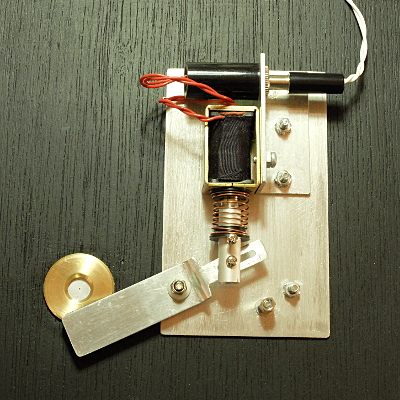

The analemma was created using a process which is closely related to that used on my pinhole solargrams. But I needed to build a new pinhole camera with the specific dimensions to frame the analemma tightly on a 10x8" sheet of paper. There was also the requirement to devise an automated shutter so that I didn't need to be present to operate the camera manually at noon each day!
The camera is a simple plywood box as shown in the photo. The back contains a slot to hold a single sheet of Ilford MGIV photographic paper & is screwed in place. The pinhole was made from high quality "beer can" aluminium using the technique shown in my pinhole tech page. The shutter uses a simple mechanism, together with a small solenoid which is conveniently powered from a "wall wart" power supply and a cheap IKEA timeswitch; the latter's minimum time period of 1 minute being ideal. (The sun subtends an angle of about 0.5°. It moves 360°/24/60 =0.25° per minute, so is just slightly elongated in this period, as can be seen in the oval shape of each dot which is also blurred somewhat by the 0.5mm pinhole diameter.)
I wanted to create an image devoid of the distracting features of trees & buildings. Fortunately, my house (52°N) faces almost due south & I have a small "Velux" roof window in just the right position. With the addition of a rigid shelf & a bracket, I was able to point the camera to an altitude of 90-52= 38° and azimuth 180°. Being only 3.5° west of Greenwich, I chose not to compensate for the 14 minute error between local time and UT (GMT, our official time zone). In hindsight, I should have taken this into account as it caused the slight tilt in the analemma away from vertical.
When I set out to do this, I hadn't seen a direct photographic analemma before, only the shadow based ones. I thought it would be fun to use a pinhole camera, as it links in with the other solargrams which I make. Then I discovered that in 1979, Dennis di Cicco made what is probably the first photographic analemma, and a few other people have made them since.
A less technical way to achieve the same result is by marking the point of a shadow of a fixed object on the ground. The figure is basically the same, though flipped and stretched (depending on your latitude). It's an interesting project if you work with school kids. You only need mark the shadow point once each week to be able to draw a convincing analemma and it's a practical demonstration of Kepler's laws of elliptical planetary motion!